Tom Noonan

Commentary on horse racing and politics

  • BLOGS
  • HOME
  • HORSE RACING
  • PHOTO GALLERY
  • RACING PARTNERSHIP

Gaming Commission meeting consistent with past performances

Posted by noonante on January 29, 2019
Posted in: Horse Racing, Political/Social commentary, Politics. Tagged: Andrew Cuomo, Chris Kay, Dr. Scott Palmer, NYRA, NYS Gaming Commission. Leave a comment

The Monday meeting of the New York State Gaming Commission did not disappoint if you wondered whether they would adhere to their past performances.

There were two items of interest to thoroughbred racing participants and fans that could be discussed.  One was a proposed regulation that sought to weaken the existing rule that was adopted following an increase in racing fatalities at Aqueduct in late 2011 to early 2012.  The other was the Commission’s response to the sudden and unexpected resignation of Chris Kay as President and CEO of the New York Racing Association.

As usual, the Commission tried to start the meeting about 40 minutes after the scheduled start, but then spent an additional 10 minutes working out audio and video transmission issues.

The regulation under consideration concerned the “purse-to-price ratio” in claiming races that I wrote about here and here.  I also submitted the only public comment on the proposal.  Because the Gaming Commission had already approved the rule for adoption prior to the expiration of the legally-required public comment, and prior to submission of my comment, they had to “consider” my comment at the Monday meeting.

If you are interested in the Commission’s “discussion” of my comment, you can replay it on the Commission’s website.  Don’t worry, it will not take long.  It begins at the 1:20 mark of the meeting and ends about four minutes later.  The “discussion” is a reading of a prepared statement by the Commission’s chairperson that is simply incoherent.

It addresses none of the issues I raised, including that it was based on a secret memo by Dr. Scott Palmer that the Commission will not release, as well as unidentified supporters of the rule change, and their reason for changing it.  Nor was there any recognition of the fact that the regulatory change is contrary to the report of a Task Force Report on the Aqueduct fatalities, as well as Governor Cuomo’s order in 2012 to implement a stricter version of the regulation.

At least that part of the agenda lasted for more than four minutes.  There was no mention of the fact that the head of NYRA was apparently suddenly forced out of his position by NYRA’s Board of Directors.  I say “apparently” because there has been no official explanation for the “resignation” of Kay that the Board accepted “effective immediately.”

David Grening of The Daily Racing Form has reported that the resignation was made because Kay had been using NYRA employees to do work at his private residence in Saratoga Springs.  I have seen nothing that disputes Grening’s report.

But the Gaming Commission is one of two government agencies in New York that has legal oversight responsibility for the actions of NYRA.  They are seemingly content to blithely ignore what is corruption in New York’s premier thoroughbred operation.

Even if Grening’s report is accurate, and cites the real  –  and only  – reason for the termination of Kay’s employment, there are more questions that need to be addressed.  For starters, how does an entity such as NYRA that has a history of prior internal control issues allow such behavior to occur?  Were any other management officials complicit in this?  The employees had to report to someone who approved their time slips.

Unfortunately, the Gaming Commission has a history in which transparency and accountability are rarely present, as exemplified by these two matters,

Bad day for NYRA

Posted by noonante on January 27, 2019
Posted in: Horse Racing, Political/Social commentary, Politics. Tagged: Andrew Cuomo, Chris Kay, Franchise Oversight Board, Gabby Gaudet, NYRA, NYS Gaming Commission. 1 Comment

This past Wednesday was not the best of days for the New York Racing Association.

Gabby Gaudet, a NYRA television commentator for a couple of years, decided to take her talents to TVG.  She is an engaging and personable expert  –  adjectives rarely used to describe her remaining counterpart, Andy Serling.  For a sport in desperate need of expanding its fan base to bring in a younger demographic (and more women), Gaudet is a real asset.  Her departure will not help NYRA’s efforts to popularize its own broadcast efforts.

Then there was the sudden “resignation” of Chris Kay, President and CEO of the organization.  When NYRA”s Board of Directors accepted the resignation “effective immediately,” we can assume that it was either resign or be fired.  NYRA’s press release did not offer a reason for the unexpected action.

David Grening of the Daily Racing Form reported, however, that according to “multiple sources … the board asked for Kay’s resignation after it learned that Kay had used NYRA employees to do private work for him at the house he owns in Saratoga.”

By the standards of the Cuomo Administration, of course, this is a small-bore scandal, although certainly one worthy of being terminated from employment.  And let’s not kid ourselves about NYRA now being in private control.  The Board’s membership did not change when it was supposedly “reprivatized” from government control.  The majority of the Board consisted of either Cuomo appointees, including Kay himself, or Cuomo loyalists.

It is no longer surprising when entitled people engage in remarkably stupid behavior and exhibit serious errors in judgment.  Kay, according to the most recent public information, was pulling in more than $500,000 annually and could be expected to pay someone to mow his lawn.

What is surprising, however, is that earlier this month The BloodHorse reported that Kay and his wife made a “personal donation of $100,000” towards the New York Race Track Chaplaincy of America’s efforts to build a multi-purpose building at Belmont Park to serve track workers.  That’s a serious chunk of change, and seemingly not the conduct of someone engaging in nickel-and-dime corruption.

Kay has been a controversial figure.  (I suspect, however, that that would be true of any person serving in the job given the opinionated, sometimes dyspeptic, nature of racing fans.)  He acknowledged knowing nothing about the sport when he arrived in 2013  –  he once characterized the condition book that lists upcoming races as if he discovered the Holy Grail even though all tracks have a version.   But he developed a fluency and knowledge as he went on.

Under his leadership, improvements have been made, although some may have been initiated before he arrived.  There are the changes to the living conditions of backstretch workers  –  Board member Michael Dubb was a major champion.  He developed a new arrangement at Saratoga at the top of the stretch that changed frequently empty seating sections to something that could attract new fans and revenue.  Saratoga is also building a new structure at the other end of the grandstand that will cater to those who had been going to the temporary modular units.

Some of his “improvements” have come at the expense of the “regular Joe and Jane” race trackers who, for example, may like to go to the paddock without being crowded out by picnic tables for sale or tents serving as pop-up bars.   Then there is the monument to his ego  – a new building outside the grandstand that serves as a museum to those awarded a “Red Jacket,” a lame idea that he thinks will become his contribution to Saratoga tradition.

On balance, was he a positive force?  His selling point was that he excelled at customer service  –  or, as he called us, guests.  But he touted the Belmont Park festival, portrayed as a three-day extravaganza of great horse racing.  The best races were all moved to Saturday, with lesser stakes running the preceding days.  My memory of going on the Friday two years ago is of a “crowd” that could easily fit in my high school’s gym, and not being able to get a hot dog  – the day before the Belmont Stakes.

Is Saratoga a better experience?  I like to treat company to what I call the “full Saratoga.”  It’s the training tracks in the morning with breakfast there.  Races in the afternoon and, of course, downtown in the evening.  While the grandstand improvements are a welcome change, one cannot escape the notion that it is primarily those with large amounts of disposable income that are the real “guests.”

Whatever his shortcomings may be, however, Kay is not what ails New York racing or prevents it from improving.  NYRA does have two governmental oversight bodies  –  the Gaming Commission and the Franchise Oversight Board.  Both are dominated by appointees of Andrew Cuomo  –  just as NYRA is.

When Governor Cuomo seized control of NYRA early in his administration, he did it by trumping up charges against NYRA’s leadership and ordering reviews of alleged malfeasance at the organization.  While the results of those reviews were clearly politically motivated and phony, Cuomo got what he wanted  –  control of NYRA and removal of those who preferred to act independently and not kowtow to his whims.

Now we can see how determined the Governor is to ensure integrity at one of the nation’s premier racing jurisdictions.  If David Grening’s sources are correct, there is clearly a significant problem within NYRA.  Back in the day when NYRA conducted public meetings, there were reports from Board members with internal audit and financial control responsibilities.  Those reports were public.  As part of his effort to seize control in 2012, Cuomo has the Gaming Commission’s predecessor, the Racing and Wagering Board, issue a public report.  The Governor’s Inspector General also issued a public report.

That, however, was back before the Governor was responsible for NYRA.  While he may still try to disclaim responsibility under the “reprivatization” charade, he is responsible for the Gaming Commission and Franchise Oversight Board.

The Gaming Commission has a public meeting Monday at 1:00 at which the NYRA situation may be discussed.  They will also be discussing a weakening of an equine safety rule that I discussed here and here.  It will be broadcast on their web site, but don’t hold your breath waiting for any serious discussion.


New York weakens rule that protected horses – echoes from the 2012 crisis

Posted by noonante on January 2, 2019
Posted in: Horse Racing, Political/Social commentary, Politics. Tagged: "purse-to-claim price ratio", equine safety, NYRA, NYS Gaming Commission. Leave a comment

As a result of comments I received on my last post, I took another look at the 2012 report of the New York Task Force on Racehorse Health and Safety.  The Task Force was comprised of widely-respected racing professionals and chaired by New York’s current Equine Medical Director Dr. Scott Palmer.

The Task Force looked at the many factors that may have contributed to the 21 fatalities that occurred during racing at the Aqueduct meet of late 2011 and early 2012, with a view to identifying common elements that could be addressed by changing policies.

The Task Force looked at the “purse-to-claiming price ratio” that is the subject of a recent regulatory change approved by New York’s Gaming Commission and the topic for a hearing tomorrow.  As was stated in the earlier post, the Task Force determined that an existing ratio of 2.0 was too high to advance safety, and recommended adoption of a 1.6 standard approved by the American Association of Equine Practitioners.  Despite that recommendation, the 2.0 rule remained in effect.  The purpose of the new regulation is to allow ratios that exceed 2.0.

The Report identified the ratios that were in effect for 17 of the races in which there were fatalities.  (Nineteen of twenty-one fatalities were in claiming races.)  In only two of those 17 races did the “purse-to-claiming price ratio” fall at or below the 1.6 standard.  In ten races, the ratio exceeded the 2.0 requirement of the regulation that is being revised.  The Task Force concluded:

“All of the horses raced during a period of extraordinary claiming activity with elevated purses disproportionate to the value of the horses.”

Among the concerns raised in my prior post about the revised regulation is that the proponents of it  –  “various interested parties” according to the Commission’s General Counsel  –  have not been identified.  One suspects that NYRA’s Racing Office might be one.

During the 2012 crisis over fatalities, the Racing Office was identified as a possible culprit because, at that time, it could ignore a decision by a veterinarian that a horse should be scratched.  The Task Force concluded that the Racing Office’s goal of increasing field size “establishes a potentially critical conflict of interest.”  It went on to add that “field size, or the economic impact of a scratch, must never be a consideration when … [assessing] a horse’s suitability to race.”  (Emphasis in Report.)

The Gaming Commission is operating secretively, so we do not even know the proponents of this change or what their motivation is.  There is nothing in the public record to suggest that New York is not returning to the mistakes identified in 2012.  If economic considerations are paramount  –  as suggested by Dr. Palmer  –  and driven by field size, as we can only speculate, the outlook is not good for equine safety.

But the public has an opportunity to see the government agency charged with equine safety and integrity in operation tomorrow at the public meeting of the Gaming Commission.  There will supposedly be a discussion of comments I submitted on the proposed regulation change.  It can be viewed on their website on Thursday at 11:00.


New York weakens rule that protected horses

Posted by noonante on January 1, 2019
Posted in: Horse Racing, Political/Social commentary, Politics. Tagged: "purse-to-claim price ratio", Andrew Cuomo, Dr. Scott Palmer, equine safety, NYS Gaming Commission. 3 Comments

Update:  After completing this post, the Gaming Commission announced it would hold a meeting to discuss policy issues I had raised in comments to the regulation.  Their meeting is scheduled for Thursday, January 3 at 11:00 a.m. and can be seen on the Commission’s website.

The New York State Gaming Commission has weakened a rule they enacted to protect horses from fatal racing injuries.  The policy was adopted in April, 2012, in response to a rise in the number of catastrophic breakdowns that occurred in late 2011 and early 2012 at Aqueduct Racetrack.

The regulation established the minimum claiming price for which a horse could be entered in a race.  “Claiming races” are one of the most inscrutable parts of racing for the uninitiated.  A claiming race is one in which a horse can be bought for a specified amount before the race is run.  It is the lifeblood of racing, and the purpose of setting a claiming price is to attract horses of comparable ability.

Aqueduct experienced a sudden influx of cash for purses when the revenues from Video Lottery Terminals started coming in.  This resulted in significant increases in purses, including for claiming races.  As an example, a horse valued at $7,500 that had been running in a race with a total purse of $15,000 might now be entered in one where the total purse was $30,000.  (The winner generally gets 60 percent of the purse, second gets 20 percent and so on.)

The Gaming Commission’s predecessor adopted an emergency regulation in April, 2012, requiring that the claiming price be at least 50 percent of the race’s purse for a “purse-to-claim price ratio of 2.0.”  In the example from above, a horse could not be entered in a race with a $30,000 purse unless its claiming price was at least $15,000.

The crisis in fatalities resulted in the appointment of the New York Task Force on Racehorse Health and Safety.  It was a panel of widely-respected racing figures chaired by Dr. Scott Palmer, now the Equine Medical Director for the Gaming Commission.

The Task Force investigated the possible causes of the fatalities and made a number of recommendations. Their Report was universally praised, and has been considered a model of steps to improve the safety of the equine and human athletes participating in the sport.  New York implemented a number of the recommendations and has now seen a reduction in racing fatalities at its tracks.

The “purse-to-claim price ratio” was one of the factors examined. The Task Force concluded that the policy of entering a horse for a claiming price significantly below the purse value was an “imbalance contribut[ing] to perceptions that horses were being entered in claiming races beyond their level of competition and forced to perform to the point of serious injury or death.”

The Task Force did not consider the April, 2012 regulation of a “2.0” ratio adequate protection for the horse, and instead recommended the more stringent standard advocated by the American Association of Equine Practitioners:

“Accordingly, the Task Force believes that the purse to claim price ratio should be no greater than 1.6, in which the value of the horse is approximately equal to the winner’s share of the purse, and that the Rule should be amended accordingly.”

Governor Cuomo agreed with the Task Force’s determination on the 1.6 ratio, explicitly citing it when he issued a statement ordering implementation of the Report’s recommendations in September that year.  Despite the Governor’s order, Dr. Palmer seemed to have a change of heart and wrote a memo three days later in which he decided that the 2.0 ratio was sufficient, citing economic considerations that might put New York at a disadvantage with competing racing jurisdictions. The 2.0 ratio was not changed.

Dr. Palmer is now of the view that even a 2.0 ratio could be higher.  He wrote a memo outlining steps New York has taken to enhance equine (and human) safety.  He convinced the Gaming Commissioners that the 2.0 rule could be relaxed if a track has implemented increased safety measures.  Even though the weakened rule was put out for public comment and has now been approved as a permanent regulation, the Gaming Commission has refused to release the Palmer memo that was a key factor in the Commissioners’ deliberation.

Dr. Palmer acknowledges that there are no magic solutions that will eliminate all risk for thoroughbreds in training or racing. His 2012 memo references “degrees of risk aversion.” This appears to be a central theme in his approach to the regulatory change proposed in 2018.

In his remarks at the Gaming Commission meeting in September at which the proposed rule was approved for public comment, he recognizes that changing the rule will increase the risk for horses. At one point he stated:

“I always thought that if we were going to take away one protective factor, what do we have to take the place? What are we going to put back in that is going to protect these horses?”  (Transcript by Commission.)

What Dr. Palmer stated at this meeting is that a program of “Out of Competition Scrutiny” – not to be confused with Out of Competition Testing – would identify certain horses whose record might indicate an increased risk of injury. It is a worthwhile effort, relying on factors that have been identified as increasing the risk of racing.  The notion of a “profile” to identify at-risk horses has become widely accepted  –  it was one of the topics in the 2012 Report of the Task Force.

The new Regulation requires that a relaxation of the “2.0 ratio” can only happen if a race track requests an exception:

“The commission shall not approve such a request unless [the track] has implemented increased measures to ensure close examination of the competitiveness, soundness and safety of each horse entered in such a race.”  (Emphasis is mine.)

The regulation is clear.  “Each horse” in a race must under scrutiny if an exception to the 2.0 rule is to be made.  But that is not how Dr. Palmer described the change to the Commissioners at their September, 2018 meeting.

This is the colloquy between a Commissioner and Palmer from the Commission’s Transcript:

Commissioner:  “[s]omeone will be taking clinical history of each horse for each claiming horse?’

Dr. Palmer:  “No.…”

Commissioner:  “Is it before each claiming race?”

Dr. Palmer:  “No, it is one time….”

Dr. Palmer is the expert upon whom the Commissioners rely.  He has said he is responsible for monitoring the effect of the revised regulation.  But he has also said that he will not be adhering to the explicit language of the regulation.

This approach by Dr. Palmer appears to be “trading” one program to reduce risk for another that increases risk.  This implies that there is a certain level of risk that is acceptable. While I think most people realize that risk is an element of horse racing that cannot be eliminated completely, I question whether there would be widespread approval of a transactional approach that balances a track’s economic considerations with equine and human safety.

At their September 24 meeting, the Commissioners focused exclusively on the increase in risk and the ability to bring a halt to the new regulation if equine fatalities approached an “unacceptable” level.  While Dr. Palmer said there would be requirements on the tracks seeking an exception to the 2.0 ratio, he did not provide any examples of what those standards might be.

Just as troubling, however, is that this is a change, according to the Commission, being advocated by persons who were not identified, and neither testified before the Commission nor submitted public comments in support of the rule.  In his September 13, 2018 memo to the Commissioners, the Commission’s General Counsel stated that “[v]arious interested parties have requested the Commission to consider adding flexibility to the existing rule….”  Similarly, the Commission’s Executive Director referred to “[v]arious interested parties” having requested a rule change at the September 24 meeting.

There was a time when the “purse-to-claim” ratio was viewed as an important safeguard for protecting horses. The Task Force rejected the notion that a 2.0 ratio was adequate, instead insisting on a 1.6.  Governor Cuomo considered this to be such a significant step that he explicitly ordered adoption of a 1.6 ratio when he released the Task Force’s findings in 2012.

Now, however, “various interested parties” who are not identified have recommended a weakening of that safeguard.  The Commission has refused to release the memo that supposedly supports the change.  The apparent rationale are tradeoffs intended to mitigate the increased risk even though the standards that will be utilized have not been specified.  And it appears the Commission will not even be complying with the revised regulation.

This is a secretive process and not the way an accountable and transparent government operates.  More significantly, however, it is certainly not a way to bring about changes that will affect the safety of racing’s equine and human athletes.


Court ruling exposes hypocrisy of NY Gaming Commission

Posted by noonante on December 7, 2018
Posted in: Horse Racing, Political/Social commentary. Tagged: Andrew Cuomo, Luis Pena, NYRA, NYS Gaming Commission, Rick Dutrow, Roy Sedlacek, Steve Asmussen. 1 Comment

Following a decision by New York’s highest court last week, the rank hypocrisy and arbitrariness of the state’s Gaming Commission was exposed fully.

The case involved penalties imposed by the Commission against Luis Pena, a trainer of harness horses.  The Commission determined that Pena had committed 1,717 violations of its drug regulations between January, 2010 and April, 2012.  Let me repeat that and write it out so there is no misunderstanding.  Pena was determined to have illegally administered medications on horses one thousand, seven hundred and seventeen times in a little more than two years.  The Commission’s penalty, upheld by the Court, was a suspension of his license for three years and a fine of $2,000 per violation.

The Court did not compare this with other discipline, but about the same time the Commission was imposing this sanction, they were imposing penalties against a thoroughbred trainer.  For one violation of a post-race drug overage and one violation for possession of syringes containing a permitted medication in late 2010, the trainer was suspended for 10 years and fined $25,000 for each violation.  That trainer is Rick Dutrow, who has already served more than twice the penalty imposed on Pena.

At the risk of overstating the obvious, such disparate treatment raises questions, if not suspicions.  No two cases are alike, so I went through the public records of the Gaming Commission with respect to both men, as well as a trove of other data from Dutrow’s case.  (I wrote about the Dutrow case here, here and here.)  For the record, I have never met either Pena or Dutrow.

In neither case were the drugs “illegal” in the sense they lacked recognized therapeutic value for the animal.  Rather, the violations by both trainers involved medications that were permitted if administered outside the window specified in the regulations.  A medication would be permissible, for example, if administered more than 96 hours before a race, but not if administered within that time frame.  (The medication in the syringes possessed by Dutrow was a permissible one, but the regulations prohibit a trainer from having syringes and such drugs.)

If the nature of the drugs was not a determinative factor, perhaps the records of the trainers were.  The only thing I know about Pena is from the press release issued by the Commission when they announced the imposed penalties. In their self-congratulatory statement, they boasted about the sanction.  My thought was:  they are bragging about a sanction of a practice in which one person can commit an average of two drug violations per day, instead of being profoundly embarrassed it went on for so long?

Pena’s history of violations according to the Gaming Commission database is unremarkable.  From December, 2009 through February, 2012, he was disciplined nine times.  While that may appear to be significant, it was for the type of minor infractions that are inevitable in a strictly regulated environment  –  an owner not being licensed, Lasix being administered too close to race time, or similar lesser violations of the rules.

By contrast, Dutrow has been a controversial figure, in large part because of a personality that some describe as colorful and others, undoubtedly, as obnoxious.   He has multiple rules violations going back to at least 2000, but many are for the same sort of minor infractions committed by Pena.  There have also been significant penalties imposed in both New York and other jurisdictions.  For the three-year period ending with the 2010 issues, however, Dutrow had only paperwork violations in New York and minor drug overages in Florida and Kentucky.  New York renewed his license to continue training in 2011.

What seems to be undisputed is that Dutrow has a stellar reputation as a horseman.  Witnesses at his suspension hearing  –  including those appearing on behalf of the state  –  attested to it.  Evidence presented that I have not seen contradicted is that he a horse trained by him did not suffer a fatal breakdown in a race over an 11-year span.  A petition supporting his reinstatement last year gathered more than 2,000 signatures from those who would know him best  –  other horse people.

If we cannot discern what the Commission may have been thinking as they imposed wildly disproportionate penalties, what other comparisons may exist?  One example cited by Dutrow’s attorneys concerned the Commission’s suspension of trainer Roy Sedlacek who admitted administering opiates to two horses on race day.  The drugs were illegal, performance-enhancing, not therapeutic and compounded in such a way as to avoid detection by a testing laboratory.  For violations of anti-doping rules more severe than anything for which Dutrow was ever accused, the penalty was a five-year suspension  –  or less than what Dutrow has already served.

Then there is the case of Steve Asmussen.  The Gaming Commission determined in 2015 that Asmussen trained horses that competed at the 2013 Saratoga meet with thyroxine having been administered within the illegal time frame of its regulations.  The Commission fined him $10,000.

The Asmussen decision was three sentences long.  The decision did not mention that 58 of 66 horses run by Asmussen during the 40-day meet had been administered the drug illegally.  It also did not mention that Asmussen horses earned more than $1 million during the meet.  Nor did it mention that Commission staffers stated that the typical fine was a minimum of $500 per violation, an amount that would be at least $29,000.  Nor did the decision mention 28 prior drug violations by Asmussen that he discussed on a nationally televised broadcast, blaming them on inconsistent state regulations.

The penalties imposed on Asmussen, Sedlacek and Pena stand in stark contrast to the severity of Dutrow’s.  I constructed a time line of the cases, but added what may appear to be a completely unrelated factor.  That would be the effort by Governor Andrew Cuomo to seize control of the New York Racing Association.  Recognizing the risk of appearing to be a crazed conspiracist, it does offer what may be a significant factor, particularly given that the Gaming Commissioners are mostly Cuomo appointees.

Cuomo assumed office in January, 2011.  The Dutrow violations occurred in the preceding November.  The New York stewards issued their decision on the violations on February 16, 2011, determining that Dutrow should be suspended for 90 days.  A day later, the President of the Association of Racing Commissioners International sent a letter to John Sabini who, at the time, was the chair of the predecessor state agency to the Gaming Commission.  That was followed by a communication that a United States Senator from New Mexico was concerned that Dutrow be punished severely.  Two weeks later, Dutrow received an order to “Show Cause” why his training license should not be revoked permanently.

Following a three-day hearing, the Board adopted the decision of the hearing officer but reduced the penalty from a permanent revocation to a 10-year suspension on October 12, 2011.  The end of 2011 also marked the beginning of what would become Governor Cuomo’s successful effort to seize control of NYRA and replace an independent body with one controlled by him.

While divining the true motivations of the Governor in any context are close to impossible, it is no secret that he harbored animosity towards NYRA leadership, had  –  and has  – no interest in racing, and will resort to any means, regardless of how unscrupulous, to achieve his secret agenda.

The NYRA takeover featured threats, intimidation and bogus “reports” purportedly justifying the need for state control of what the Governor’s appointees portrayed as a  discredited institution.  The Dutrow case presented a perfect opportunity to put a face on the problems with NYRA racing.  The Pena case, by contrast, did not further the anti-NYRA narrative.  It was harness racing, not NYRA’s thoroughbred product, that was discredited.  Pena’s violations are so much more dramatic than Dutrow’s that the public’s focus would more likely focus on either racing as a whole, or the incompetence of a government agency controlled by Cuomo.  It therefore seemed important that Dutrow be connected with NYRA instead of having other salient problems addressed.

All of this may be coincidental and is, admittedly, conjecture on my part.  Nonetheless, the fact remains that the penalties imposed on Dutrow, Pena, Asmussen and Sedlacek are impossible to reconcile in any logical, legal or moral sense.

There is a way, however, for the seeming hypocrisy and arbitrariness to be addressed.  That would be for the Gaming Commission to explain its decision-making.  It is a government agency that, by law, is supposed to be an independent and impartial adjudicatory body.  It should be answerable to the public as well as the horsemen and horsewomen it serves.  But it has consistently demonstrated that it is neither transparent nor accountable.

The Commission has had ample opportunity to explain publicly its rationale for its treatment of Dutrow.  His attorneys have been petitioning them for years to reconsider its penalty  –  not to relitigate the underlying violations, but to address the severity of a 10-year ban on someone performing his livelihood.

At its July 16, 2018 public meeting, the Commission announced that it had met in secret and voted 4-2 to not reconsider its penalty.  There was neither a discussion nor an explanation.  It later released a memo attempting to justify that decision.  But the memo was written after the meeting, did not address the issues raised by Dutrow’s attorneys and is nothing more than an attempt to put lipstick on a pig.

What is at stake here is nothing less than the integrity of racing in New York.  I follow the sport closely and cannot comprehend the differences in the discipline described above  When Hall of Fame trainer Steve Asmussen gets a slap on the wrist for 29 drug violations at the state’s premier race meet, and another loses his livelihood for two comparable violations in a three-year period, one can only ask why. When a trainer who averages two violations per day gets a suspension less than one-third of one with two violations over three years, one gets suspicious.

If we expect the racing community and the public to have trust in the sport, this behavior by regulatory bodies must stop.  No one in the public or the racing community is going to trust that the sport is honest when the body charged with enforcing standards of conduct is irrational, arbitrary and hypocritical.

The Gaming Commission did not respond to my request for an explanation of the discrepancies between the Dutrow and Pena penalties.


Rick Violette

Posted by noonante on October 22, 2018
Posted in: Horse Racing. Tagged: Charles Hayward, NYRA, NYTHA, Rick Violette. Leave a comment

Rick Violette passed away on Sunday from cancer.  He was a long-time trainer in New England and New York, and a recent president of the New York Thoroughbred Horsemen’s Association.

He trained some top-notch horses  –  most recently Diversify  –  but his impact reached far beyond his activities at the barn.  He was a passionate advocate for the trainers and owners both nationally and in New York.

I attended many of the meetings of the New York Racing Association’s Board (back in the day when they were open).  Rick was a unique and  –  too often  –  solitary voice who was committed to the trainers and owners as well as New York racing.  He was smart, knowledgeable about recent history in the state, tough and practical.  He was approachable, funny and someone who fully gave of his time even with all his other responsibilities.

Trainers and owners may have been his “official constituency,” but he also chaired the Jockey Injury Compensation Fund.  Under his leadership at the Horsemen’s Association, programs for the aftercare of thoroughbreds were created.  NYTHA also funded programs for backstretch grooms and hot walkers who were not in the limelight, but essential to the health of the horse and the industry.

We too often fail to express our thoughts about someone while they are alive.  Rick is the very embodiment of all that is good about the people in the racing industry.  I do not think I can say it any better than Charles Hayward, former President of NYRA, expressed it here.

New York continues its vendetta against Rick Dutrow

Posted by noonante on August 22, 2018
Posted in: Horse Racing, Political/Social commentary, Politics. Tagged: Andrew Cuomo, ARCI, drugs in racing, NYS Gaming Commission, Rick Dutrow. Leave a comment

The New York State Gaming Commission issued a report on August 8 purportedly explaining its reasons for not reconsidering its decision to suspend trainer Richard Dutrow for 10 years.  Dutrow’s attorneys asked the Commission to reconsider only the penalty provision and shorten the suspension to “time served,” which at this point is more than five and one-half years.

The August 8 report, however, is nothing more than a post hoc rationale justifying what I earlier described as a “bag job” by the Commission to target Dutrow.  (That post explains the background of the proceeding which will not be repeated here.)

The report  –  given that it is dated August 8  –  was not discussed at the secret July 16 meeting where the commissioners decided against reconsideration by a 4-2 vote.  At the public meeting that followed, the vote was announced, but there was neither a discussion nor an explanation.  The report not only misstates the positions advocated by Dutrow’s attorneys, but also some of the evidence.  It is merely a continuation of disgraceful behavior by a government agency that has deprived someone of his livelihood.

The motion by Dutrow’s attorneys clearly states that they were not seeking to relitigate the underlying violations for which New York’s stewards imposed a 90-day suspension, but only for the “limited purpose of reviewing and modifying” the 10-year suspension subsequently imposed by the Commission.

The Commission’s regulations permit a reopening based on “newly discovered evidence” or for “other compelling reasons.”  While Dutrow’s motion cited newly discovered evidence regarding a key Commission witness, it stated that “the most compelling reason to reopen this proceeding is that to do so will serve the interest of justice.”

The Commission basically ignored the arguments on fairness, and instead repeatedly claimed that Dutrow was trying to relitigate the underlying issues.  It spent most of its 16-page report defending its original decision and the litigation upholding that decision, even though there was no contention by Dutrow’s attorneys that the Commission’s decision was wrong, or that they lacked the authority to impose the sanction they did.

Dutrow’s request for fairness is predicated upon the disproportionate penalties imposed when compared with “like or similar circumstances.”  His attorneys claimed they were the “most severe ever imposed on a trainer in American racing at any of the leading racetrack venues” going back to 2005.

But the Commission’s report did not address the questions of “fairness” or “justice.”  And there are undoubtedly people who think Dutrow is getting his just desserts and clemency is not warranted.  That’s fine.  But the Commission owes it to the citizens of New York as well as the hundreds of professional horse people supporting Dutrow’s reinstatement to explain why they think so.

I tend to be wary when a decision-maker is setting up straw men to knock down, as the Commission report does by focusing on the merits of the underlying violations  – again, not arguments being raised by Dutrow.  The thrust of his petition is the regulatory language permitting a reconsideration based on “other compelling reasons.”  There is no better way to describe this fraudulent report than to quote the entirety of the Commission’s “explanation” on this issue:

“Finally, the Commission considers whether there are other compelling reasons for reopening the proceeding as to penalty.

Having considered all of these questions, the Commission concludes, in its sound discretion, that Dutrow has shown none of the circumstances that would be required for us to exercise our discretion to reopen this proceeding.”

Seriously.  That’s it.  Dutrow’s petition exhaustively cited numerous other cases in other jurisdictions in which the penalty imposed was less severe  –  or justifiably equally or more severe  –  and the Commission dismisses it in a single sentence with no explanation.  Kind of like the way they announced their decision to not reopen the case.

One example cited by Dutrow’s attorneys concerned the Commission’s suspension of trainer Roy Sedlacek, who admitted administering opiates to two horses on race day.  The drugs were illegal, not therapeutic, performance-enhancing and compounded in such a way as to avoid detection by a testing laboratory.  For violations of anti-doping rules more severe than anything for which Dutrow was ever accused, the penalty was a five-year suspension  –  or less than what Dutrow has already served.

The Commission’s report detailing Dutrow’s “history of violations” is unable to cite anything of significance in the seven years preceding this case.  There have been overages of legal medications, including one of the violations here  –  as there are with numerous trainers  –  but not one for an illegal drug.

I will not go into the Commission inaccurately recounting two factual matters that are contrary to statements in the Hearing Officer’s report imposing the severe penalties.  Suffice it to say that it is more emblematic of an attorney’s spin on the facts.  It is why many people distrust lawyers, but this is an adjudicatory body that has an obligation to dispassionately review evidence and make conclusions based on objective and independent analysis.

The Commission’s August 8 report is a shoddy attempt to cover up a decision they were apparently embarrassed to explain in a public hearing.  That would be understandable given that they are unable to provide a coherent explanation as to why Dutrow was treated more severely than someone such as Roy Sedlacek.

My suspicion is that this is a political decision emanating from the second floor of Albany’s State Capitol.  There was the communications from Ed Martin, head of the Association of Racing Commissioners International, urging a more severe sanction after the stewards imposed “only” a 90-day suspension.  It was accompanied by a statement that a United States Senator from New Mexico had expressed his concern about the penalty.  That would be the same Ed Martin who once chaired the Commission’s predecessor Racing and Waging Board that continued to license Dutrow.  He is now the head of a national organization that continually rails against the evils of a national body telling a state agency what to do.

Regrettably, however, it is a risk-averse Governor running for reelection who is not looking for “independent” agencies in the Executive Branch to exercise any independence.  The Gaming Commission is mostly comprised of Andrew Cuomo’s appointees.  Reinstating Rick Dutrow would be a controversial decision even if it is the correct one.  It is unfortunate that we cannot expect this state government to make the right decision if it could adversely affect the Governor, even at the expense of another’s ability to make a living.


Does New York care about horses being doped?

Posted by noonante on August 8, 2018
Posted in: Horse Racing, Political/Social commentary, Politics. Tagged: California Horse Racing Board, Dr. Rick Arthur, horse racing and drugs, Jockey Club Round Table, NYS Gaming Commission, OOCT. Leave a comment


“[Without an out-of-competition testing program with teeth, you won’t have a real anti-doping program]”

—  Dr. Rick Arthur, Equine Medical Director for California

There can be little doubt that the wide-spread perception of drugging racehorses is the biggest challenge facing the sport.  The New York State Gaming Commission has apparently decided it is not going to do anything to correct that impression.

I have obtained records from the Commission  –  the government agency responsible for ensuring compliance with anti-doping regulations  –  going back to January 1, 2014.  According to the records given to me, there has never been a thoroughbred horse that tested positive under the state’s out-of-competition testing “program.”  In four and one-half years during which tens of thousands of thoroughbreds raced in New York, not a single one had a positive test.

Out-of-competition testing is not to be confused with the standard post-race testing that occurs following every race for some of the entrants. Rather, OOCT is done at random, at tracks and off-track facilities, to identify illegal drugs that may not show up in the post-race test, or for which existing post-race testing is inadequate. Surprise is an essential component of an effective program since it makes it more difficult for cheaters to hide their conduct.

There are numerous industry leaders  –  usually the heads of organizations representing horsemen and horsewomen  –  who cite the statistics on post-race positive tests as proof that there is not a doping problem in racing.  That testing yields a positive rate of less than one per cent.  If that is the only thing looked at, they would be correct that drugging horses is not an issue.

But I have rarely met anyone not paid by a racing organization who believes that significant drugging is not a serious concern.  That includes trainers, professional horse people, owners, bettors and fans.  A survey of those knowledgeable about the sport would quickly produce a list of trainers on any racing circuit who are suspected of illegally drugging their horses.  Suspicions are meaningless, of course, unless there is supportive evidence.

The 2011 Jockey Club Round Table featured a report from McKinsey & Company that highlighted the significant negative impression of the sport by both the general public and even racing fans. According to the report, only “22% of the general public has a positive impression of Thoroughbred racing.” Perhaps even more disturbing is that among racing fans, “just 46% … would recommend their friends” follow the sport.

At the 2016 Round Table, a slide presentation referenced a survey in which 69 per cent of respondents identified “drugs” as a “very important” issue and 66 per cent cited “integrity issues.”  McKinsey is returning to this year’s Round Table and, if I were a betting man, I would not think there will be a drop in those numbers.

The perception of doping is never a good thing for any sport.  While baseball has made significant strides  –  as a result of out-of-competiton testing  –  it is still feeling the effects of the “steroid era” when the annual Hall of Fame balloting sparks yet another discussion of whether those who drugged should be denied admission.

The United States Anti-Doping Agency (USADA) has significantly cleaned up the drug abuse in cycling, American track and field, and other sports.  This would be the same USADA that some racing leaders think does not have the capability to bring horse racing to a comparable level of respect.

While the United States is a leader in the testing of human athletes, it is woefully behind the rest of the major horse racing jurisdictions in the world according to Joe Gorajc, writing in thoroughbredracing.com.  In the United Kingdom, France and Hong Kong, out-of-competition testing represents between ten and fifteen per cent of all testing. The comparable figure in the United States is two per cent.

New York is but a portion of that two percent, but nonetheless is aware fully of the importance of out-of-competition testing in identifying illegal drugs that may not show up in post-race testing.  In explaining its reason for adopting OOCT regulations in 2012, the state cited the significance of the rule for enhancing the integrity of racing and the safety of horses:

“Doping agents with these traits are posing a great threat to racing integrity. They threaten the integrity of athletic competitions by having an affect [sic] on race performance that cannot be forecast by the betting public, and that gains an unfair advantage over other horsemen and owners.… When used by healthy competitors, they have the capacity to create dangerous and unfair abilities to perform.”

But, New York’s record on OOCT is nothing short of abysmal.  I have twice been provided with records in response to requests for public records going back to 2014.   A total of 10 harness horses tested positive.  There were no positive tests for thoroughbreds.

That, of course, would be a remarkable record for a sport in cleaning up illegal use of medications.  But we do not know how many horses were tested.  The Gaming Commission’s Director of Communications informed me that New York does not maintain records on the number of horses that were tested and the number of negative tests. So the agency responsible for ensuring the integrity of racing does not keep track of its own performance in reducing illegal doping.

This is particularly disturbing since it did have such records as recently as 2016. In that year, there were “approximately” 1,100 samples taken, of which 21 came back positive.  (I had requested records going back to January 1, 2014.  In October, 2016, the Commission gave me records of six positives, all occurring in March of that year and all for harness horses.  I assume the discrepancy between 21 and 6 can be explained by positives detected after the response to my request for records.)

It is not clear why the Gaming Commission would abandon the collection of data that would be essential information in assessing the success of its efforts in reducing illegal doping.  That is, of course, if they are truly doing anything significant, about which I have serious doubts.

One aspect of their program is that they test horses that are entered in Grade I races with a purse of $1 million or more.  Of course, everyone knows that they purport to conduct OOCT for such races, so only a complete fool would not plan around what may take place.  An essential component of an effective program is the element of surprise, which the Gaming Commission has effectively eliminated for those races.

In my first request for public records, the Commission denied statistical information because records need not be disclosed if “compiled for law enforcement purposes and which, if disclosed, would … reveal criminal investigative techniques or procedures….”

The reasoning underlying this exemption to the public records law is solid: drug cheaters “could evade detection by deliberately tailoring their conduct in anticipation of avenues of inquiry to be pursued by agency personnel.”

Statistical records concerning the number of tests, the trainers and horses tested, and the results do not allow cheaters to evade detection.  The only way it does assist cheaters is if the number of random and surprise testing is negligible over a period of more than four years.  Then the cheaters would know that New York does not have a serious program of out-of-competition testing.  Of course, they already know that.

For reasons that seem to be inexplicable, OOCT is a topic fraught with controversy.  Several years ago, I heard complaints in New York about constitutional protections, as if horses were covered by the 5th and 14th Amendments.  The California Horse Racing Board recently had a heated meeting in which organizations representing owners and trainers spewed vitriol against California’s Medical Director, Dr. Rick Arthur.  While I have never met Arthur, his reputation is that of one of the most reputable and knowledgeable figures in the sport.

Arthur was frustrated by the lengthy delays in enacting regulations in California.  Even third-party Lasix administration  –  a seemingly uncontroversial issue  –  took over a year to enact.  He explained his rationale for an effective program of OOCT:

“Everyone also knows when we are going to test the horses  –  right after the race.  That is pretty easy to plan around if you are bent on cheating.  Many of the most effective [Performance Enhancing Drugs] are gone well before race day when horses are tested but the performance enhancing effects are still present.  The effects of many drugs can last well past the time the drug is still present, or present at detectable levels.”

But If there was ever a more compelling argument for stricter drug enforcement, it was unwittingly made by the Vice-President of the North American Association of Racetrack Veterinarians who cautioned against the California OOTC proposal because of unanticipated “costs,” according to a piece by Jeremy Balan in BloodHorse Daily:

“There’s the potential loss of owners  –  people are already worried about that …. There’s potential loss of horses.  If these horses are put on the vet’s list for six months, because of anabolic steroids, then that takes them effectively out of the population, and that’s a big issue right now.

There’s going to be a cost and a loss of integrity.  We’re going to have positive tests.  It’s inevitable.”

Uhh … seriously?  Owners will not be coming in if they cannot administer illegal drugs to their horses?  And that’s a negative?

But a loss of integrity does not come from a positive drug test.  It comes from not caring whether horses are being illegally doped.  When a minor league baseball player is assessed a lengthy suspension for testing positive for PED’s, that enhances the integrity of the sport, not diminish it.

New York’s lackadaisical attitude towards OOCT is particularly disturbing for a number of reasons:

  • It typically takes in 20 per cent of the national betting handle, meaning that bettors cannot be confident they are getting an honest product;
  • Transparency is always a beneficial characteristic, but even more so in a business where suspicions and rumors tend to be rampant;
  • Disclosing the identities of trainers and horses who have been tested would be a benefit to all, but particularly to those who are the subject of the “knowing whispers;”
  • Publicizing data on testing is the most effective deterrent there can be.

My fear, however, is that New York’s program  – to the extent it even exists  –  is nothing more than a sham.  How can it be that not a single thoroughbred tested positive over a period of more than four years?  Even the positive tests on harness horses are minimal and come at suspicious intervals.  In 2016, the six positives were in one month.  The positives in 2017 were within two weeks and only for horses entered in that sport’s Sire Stakes.

And if New York cared about illegal doping, it would not have abandoned the collection of data that recorded the number of tests and results.  At a time when the Governor is making a big deal about paying for a license for a child’s lemonade stand, one would hope that those in charge of racing integrity could make the minimal effort needed to track their progress or  –  more likely  –  the lack of progress in curbing doping.

At the Jockey Club’s 2016 Round Table Conference, Jeff Novitzky, the Executive Director of the Ultimate Fighting Championship, relayed his experiences in combatting drug abuse by human athletes.  When he asked athletes why they cheated, the most common responses were that they neither trusted their competitors to be clean, nor did they trust their sport’s oversight body to enforce a level playing field.

Unfortunately for those playing by the rules in New York, as well as for those wagering on its product, there can be no confidence that New York is serious about a racing program with integrity.

There is excellent reporting on OOTC by The Thoroughbred Racing Commentary, including articles by Charles Hayward and Joe Gorajec, as well as The Paulick Report.


New York’s treatment of Rick Dutrow is a disgrace

Posted by noonante on July 30, 2018
Posted in: Horse Racing, Political/Social commentary, Politics. Tagged: Andrew Cuomo, ARCI, horse racing and drugs, NYS Gaming Commission, Richard Dutrow. 1 Comment

I was initially skeptical of the effort to reinstate Richard Dutrow’s training license, even writing this post.  I have since reviewed many of the documents filed in the case with the New York Gaming Commission, including the transcript before the Commission’s hearing officer.  I now think Dutrow may well be the victim of a bag job orchestrated by the Commission and its bureaucratic predecessor, the Racing and Wagering Board.

In the latest development in the case, the Gaming Commission had one of its typical meetings  –  started late, lasted 20 minutes and had no substantive discussion about anything.  The effort by Dutrow’s attorneys to reopen the case to reconsider his 10-year suspension was discussed prior to the meeting and rejected on a 4 – 2 vote.  It was neither discussed nor explained in the public meeting.

Dutrow has been a controversial figure. He achieved national attention in 2008 when he trained Big Brown to win the Kentucky Derby and Preakness. He did not shy from the media spotlight, displaying an exuberant personality.  He also had a reputation for illegally drugging horses.  When he admitted to using steroids on his horses  –  a legal medication at that time –  it created additional controversy.

In 2010, a search of his office at an Aqueduct barn uncovered three hypodermic syringes filled with xyzaline, a medication used to alleviate lameness and calm a nervous horse. Seventeen days later, a horse trained by Dutrow tested positive for the medication butorphanol in a post-race urinalysis.

The stewards at Aqueduct issued a 30-day suspension for possessing hypodermic needles, and 60 days for the post-race positive in early 2011.  The Racing and Wagering Board then issued an Order to Show Cause why Dutrow’s license should not be suspended or revoked.

The case went to a hearing officer who found against Dutrow on all counts on September 22, 2011. He recommended $50,000 in fines and a permanent revocation of his trainer’s license. The Commission upheld the report of the Hearing Officer in all respects, but reduced the permanent revocation to a 10-year ban.  The ban went into effect in January, 2013, following the completion of litigation.

After Dutrow served three years of the suspension, his attorneys filed a motion with the Commission to modify the penalty to “time served.”  Dutrow was not seeking to relitigate the case, but rather to shorten the penalty in the interests of fairness and justice and based upon newly discovered evidence.

The penalties ordered by the stewards  –  suspensions of 60 and 90 days  –  are significant ones.  It should be noted that both medications are legal therapeutic medications.  Indeed, his attorneys have pointed out that the amount of butorphanol from the post-race test is well within the limits permitted today.  Nonetheless, it was an overage at the time, and both the syringes and medications contained in them are permitted only for veterinarians and not for trainers.

According to the Hearing Officer, it is Dutrow’s “past history,” including “numerous” drug violations and a “consistent inability to abide by regulatory rules” that warranted his permanent expulsion from the racing industry.  In deciding whether Dutrow should be allowed to regain his license, it is necessary to examine that past history.

In the field of employer-employee relations, a cardinal tenet is that termination of employment is the “industrial equivalent of capital punishment.”  While Dutrow is not an employee, the Hearing Officer and the Gaming Commission have deprived someone who has spent his entire career in training horses of the very means to support himself.

So let’s take a look at those “numerous” drug violations.

I reviewed the disciplinary record of Dutrow in New York going back to 2000.  In 2005, he was suspended for 60 days and fined $5,000 for three violations.  In early 2007, he was fined and suspended again for ignoring that earlier Commission order to suspend training.  There was also a Bute positive for which he was suspended and fined.  Since those sanctions in early ’07, he had no violations for medication overages or drug violations in New York until the ones in late 2010.

He also had a record of minor violations in Florida and one in Kentucky for overages of Bute going back to 2007.  There was, however, a suspension and $5,000 fine in New Jersey in November, 2007 for unspecified “conduct detrimental to racing.”  None of the drug violations were for a substance that is not a permitted therapeutic medication.

Between that penalty in November, 2007, and the violations in November, 2010 at Aqueduct, Dutrow had no drug infractions in New York, four in Florida for which he was fined a total of $1,750, and a suspension in Kentucky for a Bute overage.  He did have a number of minor rules violations such as not having necessary paper work on file, and “failure to attend to business in a proper manner, necessitating a late scratch.”

There is a good reason for the rules of racing, and an equally good reason for strict enforcement of them.  That applies with particular force to those pertaining to the use of medications. And I do not question that Richard Dutrow had  –  at one time, anyhow  –  either a cavalier or careless attitude towards those rules.  He is also not the only trainer who has made medication errors or been less than adroit in handling the routine aspects of running the business that is a training stable.

But, his recent record of adherence to the rules is more that of someone who has made considerable improvement in his performance, and not that of someone who is a persistent scofflaw.

Sometimes when reading a recitation of facts in a case, one can jump out as curious.  In the Hearing Officer’s report, it was the way the syringes were found.  The Commission’s Director of Investigations, Joel Leveson, was training staff from NYRA on conducting a back stretch investigation.  They happened to pick Dutrow’s barn, and happened to find syringes filled with medications.  This is curious, of course, because Dutrow is obviously not a favored figure by regulators, and it turned out to be a quite “successful” training exercise.

Three years after the beginning of Dutrow’s suspension, his attorneys received documents pursuant to a “long outstanding” request for public records.  One of the documents was particularly revealing.  John McDonnell was an investigator for NYRA being trained by Leveson on the day of the search of Dutrow’s barn.  McDonnell was a 22-year employee of the New York State Police, finishing his career as a criminal investigator.

This document from the Queens District Attorney became available because McDonnell learned that Leveson had identified him in a court hearing as the person who selected Dutrow’s barn for the search.  McDonnell told the detectives it was not his idea and “he wanted to clear his name.”  He further told them that the entire search of the barn took 10 minutes and that he was “uncomfortable with the sudden discovery of the items.”

In Leveson’s testimony before the Hearing Officer, he denied having selected Dutrow’s barn and “believed” it was McDonnell who picked it.  He also said the entire barn search took 90 minutes.

Given McDonnell’s long service in law enforcement, it is difficult to believe that he would become queasy over  –  shall we say  –  ambivalent testimony.  He was bothered enough by the events that he would only speak with outside law enforcement to express his concerns.

So why is it that a severe sanction handed down by stewards became the basis to start a process that deprived Richard Dutrow of his livelihood?  The same Gaming Commission that rendered this decision is also the one that decided in 2011 to relicense him as fit to be a trainer in New York.  And that was with full knowledge of his supposed notoriety, something that was widely known in the racing industry.

Two months after the stewards’ decision was rendered, the President of the Association of Racing Commissioners International, wrote to John Sabini, Chair of New York’s Racing and Wagering Board, urging him to revoke Dutrow’s license.  That same day, according to Dutrow’s attorneys, the ARCI President also forwarded an email from U.S. Senator Tom Udall criticizing the “light penalty given this trainer’s past doping violations.”  Two weeks later, the Board issued the “Show Cause” notice to Dutrow compelling him to defend his ability to remain as a trainer.

This was also at a time when New York Governor Andrew Cuomo’s administration was gearing up the effort to take control of the New York Racing Association.  The same John Sabini who chaired the Racing and Wagering Board that imposed the ban on Dutrow was also in charge of the effort to discredit the leadership of NYRA based on bogus charges accompanied by threats and intimidation.  (I wrote extensively about this at the time.)

So whether there was a political motive underlying the sanction against Dutrow we may never know.  It is, of course, curious that a Senator from New Mexico had a vested interest in a disciplinary action in New York.  But ARCI’s leadership has been adamantly opposed to federal legislation that would place racing under a national body to attack illegal drugging.  And the Cuomo Administration will use any tactics, no matter how discredited, to further its goals on racing  –  although no one knows what the real goals are.

But Dutrow’s personality, coupled with his widely publicized remarks about anabolic steroids, made him a flashpoint for those with ulterior motives.  One of the curious exchanges between Dutrow and the Commission’s counsel concerned his comments on steroids.  The attorney asked him several times about the publicity his comments generated, including a reference to the “firestorm of adverse publicity for horse racing.”

The use of steroids at that time was legal, and Dutrow honestly answered a question about them.  But honesty is rarely a valued commodity, even when his comments may well have been the catalyst for a ban on the drugs as a typical treatment.

Aside from possible political interference, what we do know, based on the record and statements from Dutrow’s attorneys that have not been contradicted by the Gaming Commission, is the following:

  • Dutrow did not have a serious violation of any rule between 2007 and November, 2010;
  • He was never accused of using any drug that was not a permitted therapeutic medication;
  • Dutrow had a solid reputation as a horseman who took excellent care of his horses  –  even the Commission’s own witnesses at the hearing acknowledged this;
  • Despite the perception that Dutrow was a significant violator of medication rules, not a single horse trained by him experienced a fatal injury in racing or training over an 11-year period;
  • Over 2,000 horsemen and horsewomen have signed a petition supporting his reinstatement, including many of the leading, and most reputable, trainers in the sport;
  • There is a significant discrepancy between the testimony of the Commission’s Director of Investigations and an experienced law enforcement figure who was present during the search that discovered the syringes with medications;
  • While the Hearing Officer’s decision to permanently revoke Dutrow’s license was predicated on his “past history” of rule violations, that portion of the decision consisted of a mere five sentences and did not cite a violation in the preceding three years;
  • The Commission determined Dutrow was fit to be issued a trainer’s license in 2011.

I do not know Mr. Dutrow and have never met him.  This is a record, however, that is strongly suggestive of a determined effort to “get” Richard Dutrow regardless of the merits.  I am well aware of all the buzz concerning him.  But depriving a person of his livelihood requires more than rumor and innuendo.

The Gaming Commission’s behavior at its recent meeting is a disgrace to not only the taxpayers and residents of New York but to the racing industry.  The petition before them was to reopen consideration of the 10-year ban.  That they would neither discuss this in public nor offer an explanation is a slap in the face to the entire racing industry, of which many reputable figures support Dutrow’s reinstatement.

The Gaming Commission is a public entity, the members of which are mostly appointed by the Governor.  The Dutrow matter is of public import, particularly since the Commission heralded its penalties against him in a press release.  A public airing of Dutrow’s petition could only foster a sense of transparency in government and a perception that integrity in racing is a prime concern.  And it was an opportunity to educate a distrustful public of efforts to combat unwarranted drugs in racing.

Unfortunately, the callous attitude of the Gaming Commission is all-too-typical of an Administration that believes it serves interests other than the public’s.  Their failure to discuss the matter only heightens a sense that there is something to hide, including their conduct in a matter that is now seven years old.
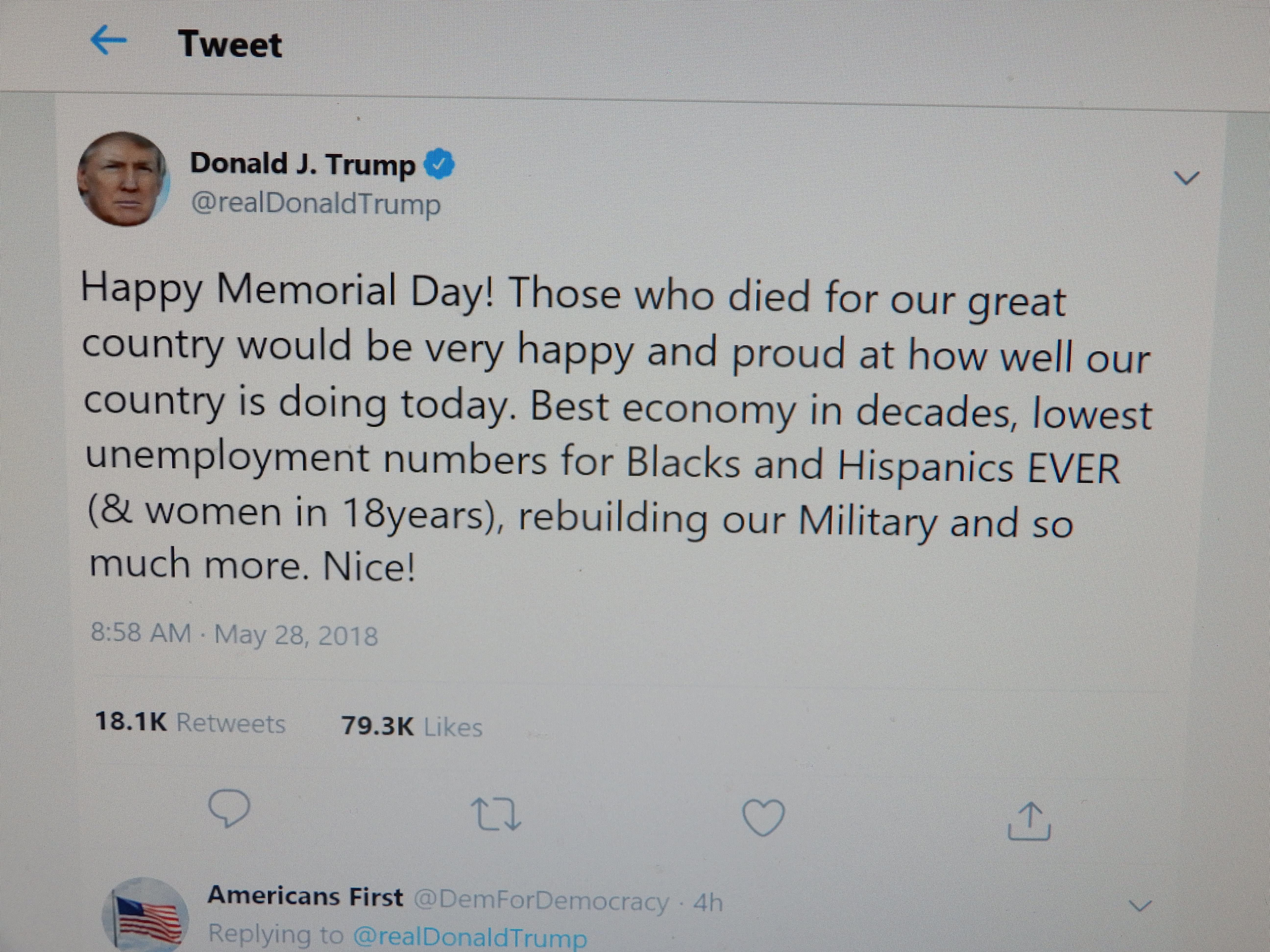
The “character” of our “President”

Posted by noonante on May 28, 2018
Posted in: Uncategorized. 1 Comment

What more do you need to know?

Posts navigation

← Older Entries
Newer Entries →
  • Archives

    • April 2024
    • January 2024
    • December 2023
    • November 2023
    • October 2023
    • August 2023
    • June 2023
    • May 2023
    • January 2022
    • December 2021
    • August 2021
    • July 2021
    • June 2021
    • May 2021
    • April 2021
    • September 2020
    • August 2020
    • July 2020
    • June 2020
    • March 2020
    • November 2019
    • October 2019
    • September 2019
    • August 2019
    • June 2019
    • May 2019
    • April 2019
    • March 2019
    • January 2019
    • December 2018
    • October 2018
    • August 2018
    • July 2018
    • May 2018
    • April 2018
    • March 2018
    • February 2018
    • January 2018
    • October 2017
    • September 2017
    • August 2017
    • June 2017
    • May 2017
    • April 2017
    • February 2017
    • January 2017
    • December 2016
    • November 2016
    • October 2016
    • September 2016
    • July 2016
    • June 2016
    • May 2016
    • April 2016
    • March 2016
    • February 2016
    • January 2016
    • December 2015
    • November 2015
    • October 2015
    • September 2015
    • August 2015
    • July 2015
    • June 2015
    • May 2015
    • April 2015
    • March 2015
    • February 2015
    • January 2015
    • December 2014
    • November 2014
    • October 2014
    • September 2014
    • August 2014
    • July 2014
    • June 2014
    • May 2014
    • April 2014
    • March 2014
    • February 2014
    • January 2014
    • December 2013
    • November 2013
    • October 2013
    • September 2013
    • August 2013
    • July 2013
    • June 2013
    • May 2013
    • April 2013
    • March 2013
    • February 2013
    • January 2013
    • December 2012
    • November 2012
    • October 2012
    • September 2012
    • August 2012
    • July 2012
    • June 2012
    • May 2012
    • April 2012
    • March 2012
    • February 2012
    • January 2012
    • December 2011
  • Categories

    • Cycling
    • Golf
    • Horse Racing
    • Political/Social commentary
    • Politics
    • Saratoga thoughts
    • Uncategorized
  • Meta

    • Create account
    • Log in
    • Entries feed
    • Comments feed
    • WordPress.com
  • Enter your email address to follow this blog and receive notifications of new posts by email.

  • Follow Tom Noonan on Twitter

    Tweets by noonan_tom
Blog at WordPress.com.
Tom Noonan
Blog at WordPress.com.
  • Subscribe Subscribed
    • Tom Noonan
    • Join 152 other subscribers
    • Already have a WordPress.com account? Log in now.
    • Tom Noonan
    • Subscribe Subscribed
    • Sign up
    • Log in
    • Report this content
    • View site in Reader
    • Manage subscriptions
    • Collapse this bar
 

Loading Comments...