Hip #1226 was purchased today at the Keeneland Sales by Avon Barksdale. At least he has the money. Keeneland should become concerned, however, when Bub signs a ticket.
Uncategorized
Late August in Saratoga is a special time. The temperatures are starting to moderate and the late afternoon sun bathes the race track in a special light. Thursday was not such a day. It rained all night, so that by early in the morning, the New York Racing Association postponed the steeplechase stake and took the remaining turf races off the grass. After scratches, the remaining nine races saw three five-horse fields, three with six and two with seven. With dark skies threatening more rain, it was not an auspicious day for going to the track. This is what it looked like in mid-afternoon:


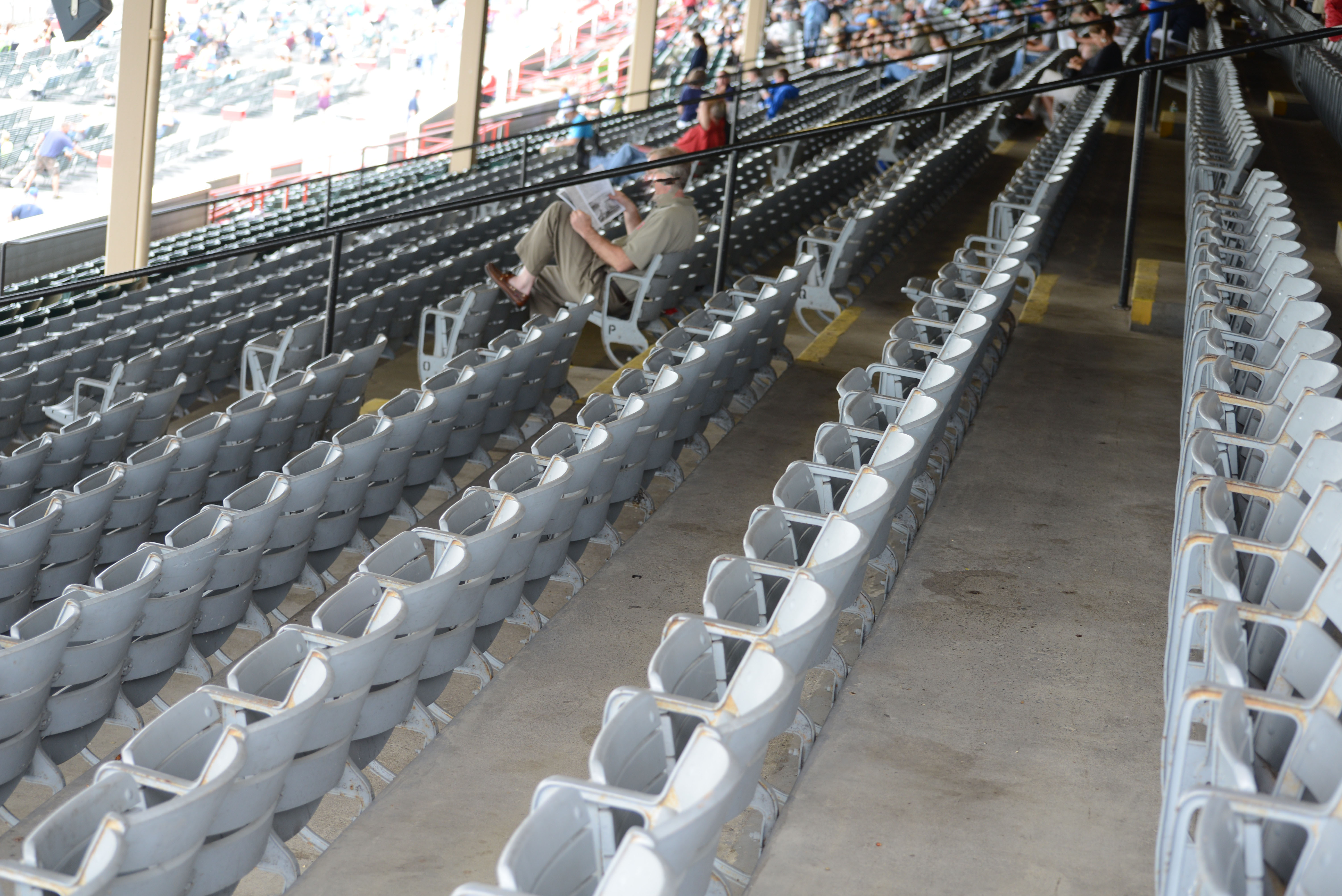
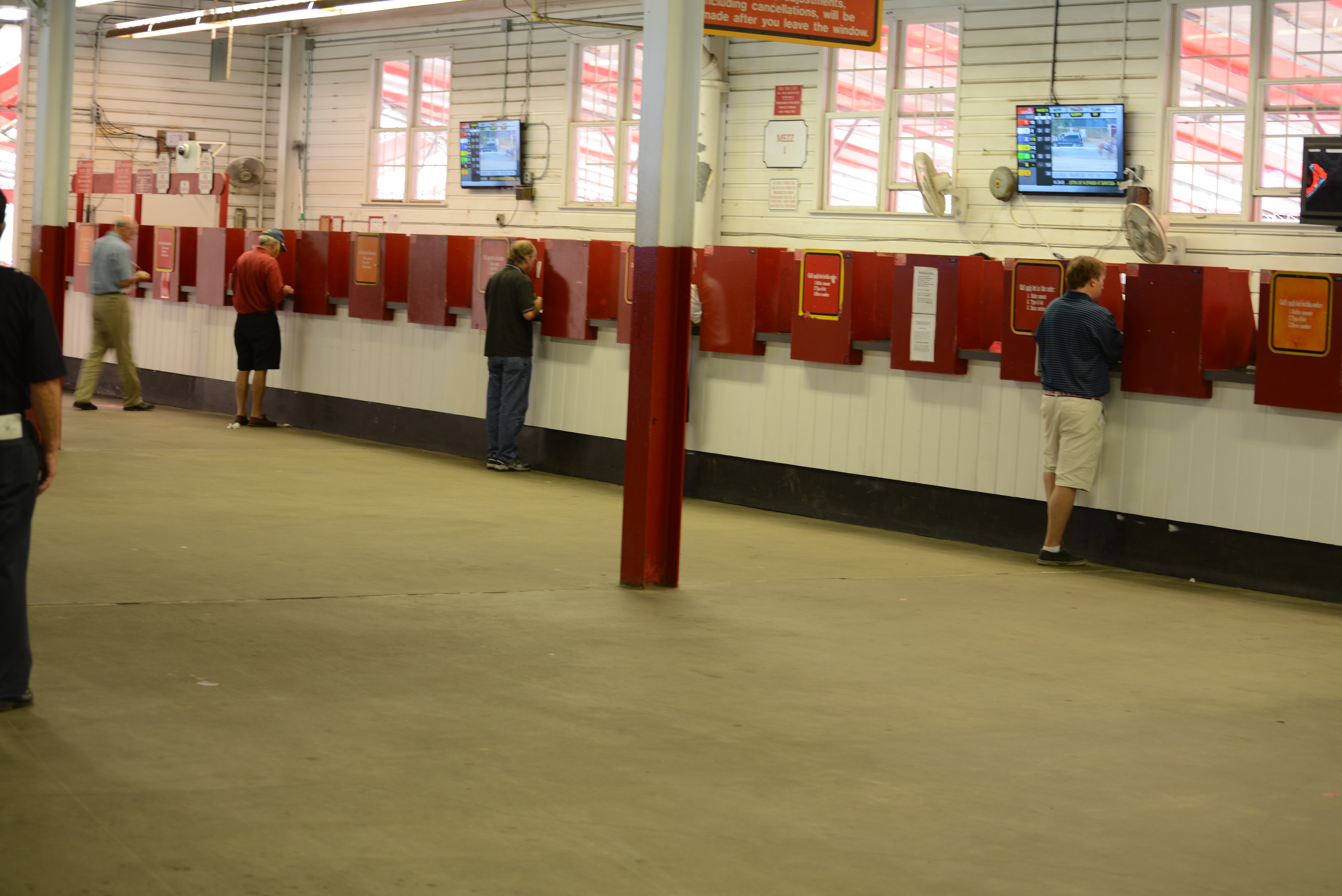
NYRA announced the attendance as 18,093. This represents a 31 per cent increase over last year’s number for the same day, when it was “fast and firm” for the whole day. NYRA’s cooking-of-the-books on attendance has been written about previously, with Paul Post of The Saratogian discovering that NYRA counts some 6,000 season passes in the attendance figure, whether or not a pass holder actually comes to the track.
What is not clear is why NYRA persists in falsifying the attendance. At this point they may feel backed into a corner. But no one believes their numbers – neither the racing industry nor the fans who do show up. My theory is that NYRA is little more than an arm of the Cuomo reelection campaign. No straight talk, just happy talk.
There has been speculation in the mainstream media that Cuomo is seeking to drive up his victory margin – you know, just like Chris Christie did last year before “Bridgegate” broke. I mean he has even sued to keep Zephyr Teachout off the ballot, as if she could possibly pose a threat to $30 million in campaign funds and an incumbent who still has decent favorability numbers.
Were it not for that pesky United States Attorney hauling members of his Administration before a grand jury, everything would be rosy in Cuomoland. We’ll just have to put up with the ludicrous announced attendance figures as we await the end-of-the-meet press release breathlessly informing us what a tremendous success the meet has been. Perhaps they will explain how attendance could experience such a dramatic increase, but handle is essentially flat as David Grening has been reporting in the Daily Racing Form.
Saratoga’s first week is in the books. As with so much else that differentiates summer in Saratoga during the race meet from the rest of the world, a week is not seven days. The first week is only four days and the remaining six are six days. Here are the observations of one person:
- Quality of the racing cards is generally good: In recent years, there has been an abundance of 5 1/2 furlong turf races and low level claimers, many of which were at six furlongs. So far, we have been treated to a variety of races, including honest-to-goodness allowances. Only three claiming races of $20,000 were run, and only six turf races at 5 1/2. The fields were of good size except for the number of short fields on “giveaway Sunday,” where five of the races had fields of six or fewer. I hope that is not an indication that NYRA thinks they can get away with short fields if they are giving away what they describe as a “premier prized mementos.”
- But how much longer will these stakes retain their grade? The opening day feature has been the Grade II Schuylerville. This year’s running attracted a field of only five, forcing NYRA to make it the third race on the card to make for more attractive betting opportunities in the later multi-race exotic wagers. I read somewhere that the winning Beyer was only a 68. The CCA Oaks on Sunday was a Grade I event that attracted all of six entrants, none of whom had yet won a Grade I. The purse was $300,000, which makes the running of
TapitureUntapable in the Haskell a sensible decision given that a second-place finish there would be a larger purse than winning a race that had been a significant event for three-year old fillies. - Is attendance up or down? It is going to be somewhat difficult to make meaningful comparisons between this year and previous ones since NYRA has decided sensibly to no longer include the “spinners” on giveaway days in the paid attendance. But the Friday, Saturday and Monday attendance was about where it was two years ago, with the average for the three days being 56 customers higher this year. Last year saw the meet open with such oppressive heat that the biggest discussion on Opening Day was whether to cancel.
- NYRA’s cosmetic changes are mostly positive: The new monitors are an improvement, and the added picnic tables in the backyard are less obtrusive than I expected. Enlarging the downstairs clubhouse restaurant removed some of the benches, but still left some in place. One negative on the picnic tables, however, is that by placing them so close to the paddock, the ability of fans to go to the paddock has been seriously restricted. On the weekend, some of those tables near the paddock were covered by tents, meaning access was even more limited.
- Who are the guys with NYRA badges who seem to have nothing to do? I spent a delightful Monday afternoon just walking around in the backyard area. I was struck by seeing several employees with the NYRA name tags who seemed to have nothing to do. I realize they may be yet more customer service representatives – in addition to those at the “May I help you” stations upon entering the track – but it was kind of puzzling. Perhaps if there was a bigger crowd they would have some work.
That Monday walking around made me realize how much we can take the Saratoga experience for granted. While going to any race track can be a venture from the real world to a different, totally contained one, Saratoga is more akin to a fantasy. It’s a beautiful facility located in the nice part of town, and features the best race meet in this country if not the world. And it is but a short walk to a vibrant downtown or a short drive to beautiful country, whether it be the farms five miles away or the start of the Adirondack mountains 30 miles from here.
Yet it is a fragile environment for racing in New York. The government-controlled NYRA is preparing a plan for the future structure of racing in New York. One news report said the draft would be ready next month, but there is no indication that NYRA will share it with either the public or the tens of thousands whose livelihood depends on the racing and breeding industries.
Then there are the signs that NYRA’s management just doesn’t get it. There is the limited access to the paddock. They stopped selling clubhouse passes after marketing them in what I thought was a great way to blunt the criticism for increasing prices this year. It is hard to believe that they are so strapped for cash that they would curtail one of the best fan-friendly initiatives they have – with the increased handle that would accompany those going more often because of the pass.
In a press release they issued after the first weekend, they actually hailed an event that show-cased an “all natural, cold-pressed, no concentrate, no sugar added juice” that you may only have seen in Thruway rest stops – I’m not making this up. This would be the same weekend in which they gave up on an ill-conceived idea to limit the availability of a beloved, free newspaper, The Saratoga Special, which has done more to promote interest in Saratoga’s racing than all of their over-the-top press releases.
We should not lose sight of the fact that this is Chris Kay’s second year at the Spa. After the fiasco the Belmont Stakes was for many fans – with no apology forthcoming – he continues to make rookie mistakes.
The Blue Ribbon Belmont Stakes Analysis is up on the Horse Racing page.
The Board of Directors of the New York Racing Association held the only meeting it is scheduled to have over a six-month period on Wednesday. The public portion of the meeting lasted all of 56 minutes. The meeting’s brevity and lack of any meaningful discussion indicates either that the real discussions are happening behind closed doors in violation of state law, or that there are no meaningful discussions. I am not sure which is worse.
It is not as though NYRA does not have significant matters on its plate. It is charged with recommending a reprivatization plan to the Legislature by April 18 next year. In addition, NYRA continues to operate a deficit in its racing operations, and must decide what, if anything, to do about the VLT revenues that enable it to operate in the black. Then there is declining attendance, even at its signature Saratoga meet, and the question of whether Aqueduct should remain open.
You would not know from attending the meeting, however, that anything is amiss. CEO Chris Kay engaged in his typical happy talk. You have to give him credit, however, for mustering enthusiasm for a Belmont Stakes music line-up that includes Frank Sinatra, Jr. and an Eagles cover band. Board Chairman David Skorton proclaimed that it was a “very positive year,” that NYRA was “closing in on a balanced budget,” and added that Belmont Stakes Day is a “perfect example of the progress we have made.”
There is no question that June 7 has the potential to be a special day of racing and handicapping with six Grade I events. But the hopefully outstanding card was achieved by eviscerating Belmont’s Memorial Day, an event that had featured the Met Mile and two other Grade I’s. This year the feature was a Grade III that lured a less-than-robust 6,946 patrons through its turnstiles.
But in terms of the “progress” claimed by Skorton, it is not clear what he means. NYRA ended the first quarter with a loss of $10.2 million from racing operations even though handle from all sources increased compared with the same three months last year. Even after including the revenues from VLT”s, the deficit was, as Chris Kay reported, “only” $1.5 million. Attendance at Aqueduct was down six per cent from last year despite three more racing days. (Yes, I know it was an unpleasant winter, but I believe the facility has heat.)
I fear that Skorton’s notion of progress has nothing to do with improvements for fans or the horsemen, but rather just the fact that they are not the old and discredited NYRA. (Many of the improvements at tracks were actually initiated by the former group.) Neither NYRA’s leaders nor other high-level state officials miss an opportunity to boast about their running racing in an open and transparent manner. The reality, however, is that NYRA does neither.
NYRA is required to follow New York laws governing access to public records and public meetings. I have detailed previously NYRA’s blatant disregard for the public records law. The NYRA Board misrepresented the financial terms of CEO Chris Kay’s contract and then attempted to cover up the distortion. This latest meeting of the Reorganization Board indicates they may be taking a similarly cavalier approach to the open meeting law.
At his first meeting as Chairman, David Skorton stated that all meetings of both the full Board and its committees would be public. The Executive Committee, chaired by Skorton, has never had an open meeting; the Finance Committee has never held one; the Long-Term Planning Committee has never held one.
The full Board does conduct a public meeting, but it is so devoid of content and serious discussion that it is legitimate to question whether it is just a sham to feign compliance with the law. If it is indeed a sham, it raises the possibility that meaningful discussions on the future of New York racing are taking place in secret.
The other possibility, of course, is that no such discussions are taking place, even behind closed doors. It was at last August’s Board meeting that Chairman Skorton stated that NYRA should start operating as if the VLT revenues are no longer there. His proposal was greeted with significant dissent, an unusual occurrence for this Board. Since then, there has been almost no mention of this crucial matter. Nor has there been an actual discussion of what is being considered for the reprivatization report that is due in a little over ten months.
The bottom line is that it is now almost two years since the Governor rammed through a somnolent Legislature, with the approval of a flaccid NYRA Board, a takeover of the organization running Saratoga, Belmont and Aqueduct. While they did a great deal of chest-thumping on how New York’s tracks would now witness substantial improvements with a competent and open leadership, I am hard-pressed to identify a single significant difference.
It’s been more than 10 days since the New York Racing Association was found to be in violation of the public records law and directed to provide documents to me “without further delay.” But NYRA has refused to turn over CEO Chris Kay’s contract and his performance goals that will be used to determine if he is entitled to a $250,000 bonus on top of his $300,000 salary.
I originally requested the two documents in August, was refused by the public records officer, appealed and was denied by the NYRA appeals officer. I asked the state agency responsible for monitoring the public records law for an opinion. Their decision rejected every argument NYRA used to deny access. NYRA’s lawyer is now saying they need more time to “review” a decision that is perfectly clear.
Now it is one thing to have a good faith dispute over the application of the public records law to particular documents. While I thought NYRA’s reasons for denying access were bogus and not supported by any of the numerous decisions by New York’s Committee on Open Government, I realize that is what lawyers do. (Full disclosure: I am a lawyer.) Now that the Committee has ruled – leaving no wiggle room – one can only surmise that NYRA has something to hide.
While one expects a government agency – which NYRA is – to comply with the law, what I find particularly aggravating is the blatant hypocrisy of top government officials in proclaiming their commitment to open government and then ignoring it.
When Governor Andrew Cuomo wrote the law that allowed the state government to seize control of the “old” NYRA, he entitled the legislation the “New York state racing franchise accountability and transparency act of 2012.” The Chairman of the Board of the “new” NYRA, David Skorton, announced that he wanted to be “very public” about the potential bonus for CEO Kay being tied to serious performance goals.
Cuomo and his allies are never hesitant about criticizing others for the moral lapses that would not taint his administration. When the Cuomo-appointed Moreland Commission request for documents was resisted by the Legislature, he pontificated: “This effort is all about restoring the trust, and restoring people’s faith in government, and I think the more information the better….” The Moreland Commission spokesperson said, “As the old adage goes, if you’ve done nothing wrong, you have nothing to hide.” (Quotes are from the Times Union.)
Then there is Robert Megna, who is Cuomo’s Budget Director and a member of the new NYRA Board. He is also a member of the Committee on Open Government (as is Cuomo’s Lieutenant Governor Robert Duffy). When the Cuomo Administration was working to force out the “old” NYRA – which was not a state agency and thus not subject to the public records law – Megna was openly critical of that Board’s failure to produce information about the CEO’s contract and other documents. Here is what Megna wrote to the then-Board Chairman:
This continuing failure to [produce documents] not only casts doubt upon NYRA’s good faith, but it also demonstrates a basic lack of moral character and fitness to fulfill its obligation as the thoroughbred racing franchisee under the [law].
What we are left with, then, is wondering what it is that NYRA is so intent on concealing. Of course, perhaps it is not just NYRA. No state agency in New York so much as restocks toilet paper dispensers without getting the approval of the Governor’s office. We know Andrew Cuomo has sights on 2016, wishing to run up a victory margin to bolster his chances – just like Chris Christie did – so maybe he also wants to hide embarrassing details about the Kay contract.
The NYRA Reorganization Board started to deal with some of the significant challenges facing it at its Board meeting on December 4. Almost all the coverage of the meeting focused on the proposal to increase admission charges to Belmont and Saratoga. General admission would go from $3 to $5 and the clubhouse would be bumped from $5 to $8. Charges for parking would also go up. No change was proposed for Aqueduct where admission is free.
While the increases affecting patrons understandably drew the most comment, the overall fiscal situation of NYRA is one that can hardly be described as rosy. At the August Board meeting, the continuing use of revenues from the Aqueduct Video Lottery Terminals was the financial issue attracting the most attention. It was clear from Governor Andrew Cuomo’s top appointees to the Board – Chairman David Skorton, President of Cornell, and Robert Megna, also Cuomo’s Budget Director – that NYRA had to start operating as if the VLT revenues were no longer available. It is a significant issue. Without the VLT revenues, NYRA’s racing operation realizes a loss; with the revenues, NYRA sees a profit. Incidentally, the loss of VLT revenues is only an immediate concern if you are the Governor – and we do not know what his thinking is on this matter, as with so many other issues affecting the state. The revenues are guaranteed to NYRA by statute.
The main purpose of last week’s Board meeting was to approve the NYRA budget for 2014. The proposal put forth by NYRA management would have the racing operation realize a $250,000 profit without factoring in the VLT revenues. That would be accomplished by cuts in spending and increases in revenue. The VLT revenues were not going away, however. The estimated $23.7 million for operating expenses from the VLT’s was to address retiree obligations of $12.5 million and an unanticipated obligation to the Internal Revenue Service of $13 million. Suddenly, the $250,000 surplus becomes a deficit of $1.5 million.
If we set aside for the moment the receipt and use of the VLT revenues, NYRA is proposing to turn a 2013 deficit in the racing operation of $10.5 million to that $250,000 surplus, from cutting costs by $3.9 million and increasing revenue by $6.9 million. The cost cutting is achieved primarily through a one-time payment of $3 million to the OTB network in 2013. The other big-ticket cuts are $400,000 in utility savings by closing the Aqueduct training track when there is not racing at the track, and $576,000 in outside legal fees. On the revenue side, fully one-third of the budgeted increase results from on-site track customers in the form of increased admissions, parking, programs and the food and beverage concessions. The increased costs to patrons are one of the only revenue increases over which NYRA has complete control. While the budget contemplates increased simulcasting fees of $1.6 million and additional sponsorship payments of $1.3 million, these are aspirational projections contingent upon successful negotiations.
The Board debate on increasing customer charges is one of the few issues on which this Board has seen a spirited debate in its year of existence. (I can only think of two other cases in which there was significant dissent.) It is clear NYRA needs additional revenue, even if you assume the VLT revenues are here to stay. What is less clear, however, is whether increasing admission and parking charges – estimated to be worth about $2 million – would be offset by a decline in attendance (and handle), resulting in either no net benefit or a financial loss.
I have had a mixed feeling about admission prices at race tracks ever since I started going. On the one hand, I did not understand why tracks did not let people in for free. While there may be folks who go to a track and don’t spend a penny, most are going to wager at least something. I don’t think I have ever brought anyone to the track for the first time who did not bet on every race. On the other hand, it is one of the cheapest entertainment expenses imaginable. For $3 (or $5), you get to go to a beautiful facility, watch magnificent animals up close, engage in the excitement, and wager. Kids get in for free. That’s why I do not think the small increase in prices will deter many, if any, people. (I do not know what the parking increases will be. That is something, I think, that could irritate enough people to cause folks to go elsewhere.)
That’s not to say, however, that NYRA was particularly brilliant in how it handled this issue. It is the kind of matter that is going to bring out the naysayers always on guard for any affront – just read some of the comments in the on-line media. (I think I have seen a single comment defending the decision.) While the 2014 budget had to be approved this month, it did not mean that the price increase could not have been floated in advance. NYRA may think it has a deep well of goodwill, but they have done little as the “new NYRA” (which is how they have started to refer to themselves), and what they have done is invisible to much of the public.
Then there are components of the budget that raise eyebrows. CEO Chris Kay is hiring additional executive-level staff, including something called a “Chief Experience Officer.” That would be in addition to the existing Chief Marketing Officer and a Vice President for Hospitality and Guest Services. There is also $800,000 set aside for a “long term planning consultant.” This is a Board that was appointed 14 months ago, named a “long-term planning committee” 10 months ago, and is down to its last 16 months before it must produce a recommendation for turning the “new NYRA” back to an “improved new NYRA” that will eliminate state government control. After apparently doing no long-term planning, they are down to paying top dollar for someone to tell them what to do. Then there is an item notable for its omission from the budget document. Prior CEO Ellen McClain proposed an effort to bring betting terminals into restaurants in New York City. Not only would this be a major benefit for racing fans in the largest United States market, but would greatly enhance revenues to NYRA. It’s hard to believe that you can go to Manhattan and not be able to place a legal bet, but nothing has apparently been done on this proposal since McClain left.
In his remarks supporting the increased charges on customers (or, as he likes to call them, “guests”), Kay acknowledged the importance of bringing “significant value” to justify the increased costs. In a speech this week, he referred to the “countless e-mails and letters telling us the wonderful things we’ve done,” according to Tom LaMarra in BloodHorse.com. Kay was not more specific, although I must say I did have several NYRA employees greet me in a friendly manner this year at Saratoga. The one specific I have heard from Kay is that increased satisfaction from patrons should not be measured by the decline this year in Saratoga’s attendance, but rather in the fact that those who did come spent more money on concessions and souvenirs. He attributed this to his increased focus on the “guest experience,” which would make him somewhat of a miracle worker since he started in the job just before the Spa opened. For 2014, the only “significant value” he has identified is High Definition TV’s. At this point, I think most people would take that as a given, rather than something warranting increased prices.
When NYRA Board Chairman David Skorton pushed for the authorization to increase prices on its customers, he repeatedly referred to the Board’s “fiduciary” duty. The Board undeniably has that responsibility, but it doesn’t end with jacking up prices. It means you also question the wisdom of $800,000 to do the long-term planning many people think was a primary duty of this Board, or the necessity of a “Chief Experience Officer,” when, again, many think that’s why this Board was appointed. Or it means you do something about placing betting terminals in New York City’s restaurants, a revenue enhancer that would lessen the pressure to increase costs for the customers who go to the track. Finally, exercising one’s fiduciary responsibilities means you push back on a Governor who is hell-bent on eliminating the VLT revenues – monies realized not from the state’s coffers but from the profits of a casino operator – if that is necessary to ensure a viable racing and breeding operation in New York State.
As I said earlier, I have mixed feelings about increasing admission prices. I would feel a lot better about it if I thought the Cuomo Administration and his top appointees were showing any interest in actually making it better for the racing and breeding businesses in the state.
See UPDATE on this issue posted on September 15, 2013
In a major reversal, Christopher Kay, President and CEO of the New York Racing Association, is going to undo one of the significant reforms implemented after the report of last year’s Task Force on Racehorse Health and Safety. Kay has decided that NYRA’s Veterinary Department will report to the Senior Vice President of Racing Operations when he starts his job at the end of the month. Since the Report, the Veterinary Department has reported its decisions on scratches to the stewards. While this may seem like nothing more than bureaucratic shuffling, the reporting relationship of the veterinarians was a critical problem identified by the Task Force.
The Task Force was appointed in early 2012 following an uptick in fatal breakdowns during the Aqueduct winter meet of 2011-12. The panel consisted of four widely-respected experts in racing, including two prominent veterinarians, Scott Palmer and Mary Scollay-Ward, Alan Foreman, head of the national Thoroughbred Horsemen’s Association, and former jockey Jerry Bailey. The group conducted a comprehensive analysis of the Aqueduct fatalities and released a 100-page report that was universally praised for its comprehensive and thoughtful analysis and recommendations. Governor Andrew Cuomo expressed his commitment to making equine safety “the top priority of horseracing.”
The Task Force looked at a number of factors that could have played a role in the breakdowns – safety of the racing surface, medication rules, violations of the drug rules, and even the aberrant weather for that time of year in New York. Foremost among their concerns, however, was that the NYRA Veterinary Department reported to the Racing Office. The Task Force described this relationship as a “critical conflict-of-interest” that “must be changed immediately.”
The conflict arises from the differing objectives of the Racing Office and the Veterinary Department. The latter is charged with ensuring the safety of equine competitors so that only sound horses are allowed to race. The Racing Office, by contrast, has a major focus of providing large fields for bettors, because larger fields means an increase in the wagering handle – and more revenue for NYRA. As the Task Force Report observed:
Racetrack management has a vested interest in maximizing field size. Conversely, field size, or the economic impact of a scratch, must never be a consideration when an examining veterinarian assesses a horse’s suitability to race.
The vets begin each race day by conducting physical examinations of the day’s entrants. If a horse does not pass this inspection, the vet would recommend a scratch to the Racing Office. The Task Force Report recounts examples of interference by trainers and Racing Office personnel seeking to overturn the decision to scratch. In one such case, a trainer dissatisfied with a vet’s assessment of a horse succeeded in getting the Racing Office to bar that veterinarian from examining the trainer’s horses in the future. The Task Force also reported personnel in the Racing Office refusing or overturning the scratch recommendations of a veterinarian. The Report described an atmosphere in which non-veterinarians felt “empowered” to challenge the decisions of the vets: “The success of some of these challenges created an environment in which veterinarians felt intimidated and reluctant to make unpopular scratch recommendations.”
The Task Force recommended that the Veterinary Department report to the separate agency that regulates racing – now the Gaming Commission. Barring that preferred resolution, the Task Force said that the vets should report to the stewards, an approach adopted by NYRA over a year ago. That is the decision that CEO Kay is now reversing by having the Veterinary Department once again report to the racing operation.
Even if we ignore the wisdom of this decision, the timing could not be more inapposite. While NYRA’s spring meeting at Belmont experienced a significant reduction in racing fatalities this year, the trend was reversed at Saratoga. The Belmont fall meet saw four catastrophic breakdowns compared with last year’s six, but the Aqueduct fall meet has already had one in its first week. But it’s the Finger Lakes Racetrack that is experiencing an increase in fatalities reminiscent of the Aqueduct crisis that sparked the convening of the Task Force. It’s not a NYRA track, but is one under the jurisdiction of the Gaming Commission. While the current NYRA leadership fancies itself as the racing industry’s leader – and, for better or worse, it is certainly one of them – the backtracking on a significant change affecting safety is not the example a leader sets.
We do not know what Chris Kay was thinking when he decided to go against a key recommendation of the Task Force. There is, however, an unsettling backdrop to the decision that embodies the fears expressed by the Task Force on this “unacceptable conflict of interest.” The Cuomo Administration, including its Chairman of the NYRA Board David Skorton, is on a mission to stop payments to NYRA from the casino company that operates the Video Lottery Terminals at Aqueduct. With the VLT revenues, NYRA is in the black; remove them and they are, once again, in the red. Making the racing operation profitable without VLT revenues is now the Administration’s prime focus.
But let’s give the final word to Governor Cuomo. His press release praising the work of the Task Force stated, “NYRA’s organizational veterinary structure was inherently conflicted by reporting to an entity (the Racing Office) whose function is inconsistent with deliberate and careful equine risk management practice.” That is the structure CEO Kay has decided to bring back to NYRA.
Trainers look for the best available jockey for their horse, and the many trainers often have a “go to” rider. Here are five trainer/jockey combinations with their respective winning percentages (for all horses) for 2013. Rank the combinations from highest winning percentage for 2013 to lowest.
Steve Asmussen (23%) – Rosie Napravnik (24%)
Bruce Levine (19) – Joel Rosario (23)
Todd Pletcher (26) – John Velazquez (20)
Rudy Rodriguez (17) – Joel Rosario (23)
Rudy Rodriguez (17) – Cornelio Velasquez (18)
Go to the Horse Racing page for the answer.
The facts are from today’s Daily Racing Form.
Since there was an Eclipse Award for Horse of the Year in 1971, only three winners of the Jim Dandy were a Horse of the Year. Who are they? Hints: Two of them won the Belmont Stakes and one answer is kind of a trick.
Go to the Horse Racing page for the answer.
The facts are from Wikipedia and the late, much-lamented Thoroughbred Times Racing Almanac.
 Tom Noonan